What is a day service?
The term Day Service is used here as an umbrella term to describe non-residential services that provide support to people experiencing homelessness. These services may include day centres, resource centres, hubs, advice centres, and a variety of other models, and are often the first point of support for people experiencing rough sleeping and other forms of homelessness.
Day Service provision ranges from small drop-in services offering essentials like food, clothing and basic support, to more structured services delivering specialist advice, casework, training and learning opportunities.
In England in 2025...
-
172
day services supported approximately 76,200 people accessing them
-
80%
of services are funded primarily from grants, individual donors and fundraising activities.
-
17%
of services receive their main source of income from commissions from the Local Authority and only 39% overall receive any local authority contracts or commissions.
-
39%
of services receive any local authority contracts or commissions at all.
-
46%
of services reported that increased financial pressures mean that their organisation risks service closures.
-
20%
of services report making redundancies because of increased financial pressures.
For more information on the national shape of Day Services, head over to our annual Support to end homelessness report.
What is the role of a Day Service?
Homeless Link established a co-creation group in 2025 made up of over 30 services. The group identified Day Services as places of connection, belonging and progression that support people on their journey out of homelessness.
The core role of a Day Service is to:
- provide a safe, welcoming and non-judgmental space for people experiencing homelessness who may feel isolated and disconnected. Day Services are places where people feel a sense of belonging and are heard and valued. This helps to create an environment where people can engage with support and is an essential first step to moving beyond trauma.
- help prevent crisis, but often also support people who are already in crisis, working to alleviate immediate needs while helping them move forward
- support progression by helping people resolve housing and other challenges, while building confidence and self-efficacy.
- provide support across issues such as housing, health, meaningful activity and employment, offering a consistent and trusted presence for people as they navigate complex challenges. Acting as a ‘bridge’, they help people access the right agencies and improve communication across sectors through strong external partnerships.
- support personal growth by valuing participation and offering leisure and learning activities that build strengths, self-esteem and self-efficacy, empowering people to move beyond homelessness towards positive futures.
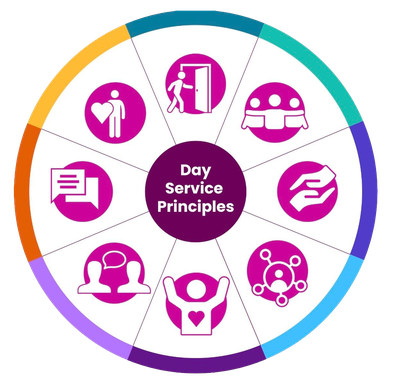
Day Service principles
Homeless Link's Principles for Day Services set out how to operate an effective service.
These principles – developed with services across England, people with lived experience, Expert Link, and Housing Justice – provide a framework for effective practice.
Strategic Value of Day Services
-
Engagement
Day Services are able to reach and engage with a wide range of people because they are often centrally located, visible, well known, open access or low threshold, and open at accessible times.
-
Crisis support
Day Services are uniquely positioned to provide crisis support. They help meet immediate needs by providing essential items, facilitating referrals to emergency housing and other key services, delivering timely interventions for people who may struggle to engage with mainstream support, and assisting with the delivery of emergency provision including severe weather emergency provision (SWEP).
-
Community, belonging and progression
Day Services provide a sense of connection for people who often experience isolation and exclusion. By bringing people together, they help build social connections, reduce loneliness, build agency through increasing self-esteem and confidence, and support progression towards longer-term goals.
-
Hub/Partnerships
Day Services play a vital role in bringing together agencies and services to provide a ‘one stop shop’ approach for people experiencing homelessness who may otherwise be excluded from support. They facilitate referrals and signposting, provide space for partner agencies to meet with individuals, bring multiple services together in one location, and create a trusted environment that improves access to support and engagement with services.
Trauma-informed Day Services
To run the most impactful services, Day Services should apply the principles of Trauma-informed care which includes being strengths-based as well as valuing collaboration and coproduction.
Trauma-informed care (TIC) is a relationship-based approach which can be adopted by organisations to improve awareness of trauma and its impact. This is an approach that can be applied in all settings, including Day Services.
Adopting a Strengths-based approach, collaboration and coproduction are an important part of being trauma-informed, helping people to re-build control over their lives and move beyond homelessness.

Running an effective day service
Managing a Day Service involves overseeing governance, policies, and daily operations while ensuring the organisation remains sustainable and effective. Our leadership support and networking opportunities, governance guidance from the National Charity for Voluntary Organisations (NCVO), and peer support through the Association for Chief Executives of Voluntary Organisations (ACEVO), can help managers develop their skills and strengthen organisational practice.
Partnership working is central to successful Day Services. By working closely with local authorities, housing providers, health services, and other agencies, services can provide coordinated support and improve outcomes for people experiencing homelessness. Resources such as our partnership guidance and self-assessment toolkit, along with approaches such as Strengths Meetings and Team Around Me, can support effective multi-agency working.
Sustainable funding and demonstrating impact is a key priority for most Day Services. Homeless Link has a range of resources to support with fundraising including the Day Service Principles main publication that includes evidence that can be cited in funding applications as well as other resources to improve fundraising skills.
Supporting staff wellbeing is equally important. Working with people facing complex challenges can be demanding, and staff may experience vicarious trauma, moral injury, or burnout. Regular supervision, reflective practice, and debriefing opportunities help create a supportive and resilient workforce.
Discover more on Day Services
-
Resource
Creating trauma-informed Day Services
Guidance for Day Services on the impact of trauma, and how to adapt their approach and promote wellbeing for people accessing their services.
-
Resource
Day Service principles
Each Day Service should operate in line with its organisation’s mission and values, using clear guiding principles to ensure consistent and effective support. Homeless Link’s Principles for Day Services, developed with services across England, people with lived experience, Expert Link, and Housing Justice, provide a framework for effective practice.
-
Guidance
Being Strengths-based: collected resources
This page holds collected resources to support anyone interested in becoming strengths-based.