Day Services are often the first, and sometimes only, point of contact for people experiencing homelessness, multiple disadvantage, and crisis. They provide a wide range of vital support and should be recognised as a key part of local homelessness provision.
This page shares an overview of the eight core principles for designing and delivering effective Day Services in England, co-created by Day Service workers, sector professionals, and people with lived experience from across the country, in partnership with Expert Link and Housing Justice.
Explore the full downloadable publication at the bottom of the page, which includes research evidence that demonstrates the impact of this approach and how Day Services can help end homelessness.
Updates and changes to this page
May 2026: This page has been rewritten, but there have not been any significant changes to the information provided.
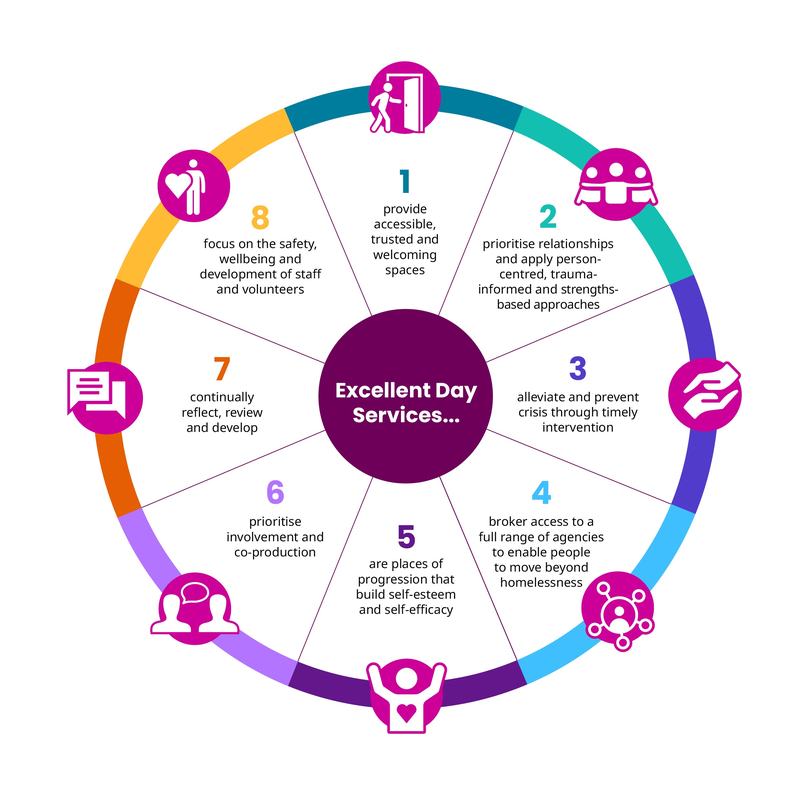
Principle 1: Provide accessible, trusted and welcoming spaces
A key feature of a Day Service is that they provide a physical space where people experiencing homelessness can find support and community. In order to engage with people at moments of acute crisis, Day Services need to be well-known and located as well as accessible to a wide range of people. This includes considering how to be inclusive of groups that may be under-represented. Day Services provide warm, non-judgemental and welcoming spaces where people can rebuild the meaningful human connection that is essential for recovery and stability.
This principle means Day Services:
- are located where people experiencing homelessness can easily access them.
- promote their services to reach all who may benefit.
- are often open-access spaces available at regular times.
- provide welcoming, non-judgemental, and inclusive environments.
- foster a sense of community and belonging.
- recognise under-represented groups and promote inclusion.
- aim to offer high-quality, trauma-aware spaces that are physically and psychologically safe.
- remain available to people needing ongoing support to prevent homelessness and isolation.
Principle 2: Prioritise relationships and apply person-centred, trauma-informed and strengths-based approaches
Day Services are well placed to build trusting relationships because of their warm, consistent, welcoming environment. Creating psychologically safe environments in this way is fundamental to supporting meaningful change. Trust, consistency and trauma-informed relationships help individuals feel able to engage with services and build resilience. By taking a strengths-based approaches, focusing on compassion, participation and empowerment, Day Services are able to support individuals to have greater agency, self-efficacy and confidence.
This principle means Day Services:
- prioritise building trusting relationships to engage people with experiences of trauma, exclusion, or multiple disadvantage.
- aim to ensure people feel respected, valued, listened to, and trusted.
- aim to provide a consistent, welcoming, and supportive environment.
- promote physical and psychological safety.
- use trauma-informed approaches to reduce re-traumatisation and improve emotional safety.
- take a person-centred, strengths-based approach that helps people identify their strengths and goals and shape their own support.
- create inclusive environments that minimise barriers and exclusions.
Principle 3: Alleviate and prevent crisis through timely interventions
Day Services play a vital role in providing immediate practical support, accessible assessment, and links to specialist services. This includes provision of food and hygiene which enables people to regulate stress and engage with support. Through flexible approaches, crisis intervention and connecting people quickly to emergency accommodation, healthcare and specialist support, services can help stabilise individuals and create opportunities for sustained engagement and recovery.
This principle means Day Services:
- rapidly assess people’s wants and needs either informally in conversation or formally using set procedures.
- meet essential and immediate needs including provision of food, showers and clean clothes or connection to other agencies that provide these.
- aim to respond quickly and effectively to crisis and emerging needs.
- have clear pathways for linking people to emergency housing as well as providing connection to urgent health, mental health, substance use, financial and other support.
Principle 4: Broker access to a full range of agencies to enable people to move beyond homelessness
Day Services often act as hubs, connecting people experiencing homelessness with essential services and agencies in an accessible and supportive environment. By coordinating multi-agency support, they help build strong local partnerships improving pathways to housing, healthcare and specialist services and helping achieve positive outcomes for people experiencing homelessness.
This principle means Day Services:
- provide access to a full range of support, both in-house and through partner agencies.
- bring services together in one location through providing hubs, one-stop shops, and on-site appointments.
- make support accessible by hosting agencies at the service, accompanying people to appointments to help them develop trusting relationships, and providing ‘navigation’ services to improve access to other agencies.
- take a holistic approach to balancing the complexity of interrelated and concurrent needs.
- build strong partnerships with other agencies through positive working relationships, hosting other services, clear communication and collaboration, and developing referral routes and information sharing protocols as needed.
- work as part of a wider network of organisations to end homelessness and rough sleeping.
- understand the wider systems and factors that impact and alleviate homelessness and multiple disadvantage.
- prevent re-occurring homelessness by providing opportunities for past attendees to re-connect with support.
Principle 5: Are places of progression that build confidence, self-esteem and self-efficacy
Day Services provide vital spaces of connection, belonging and support for people experiencing homelessness. By reducing isolation and creating opportunities for social interaction, skills development and meaningful participation, they help rebuild confidence and personal agency. Through community-based activities and relationships, Day Services support wellbeing and pathways towards longer-term stability.
This principle means Day Services:
- have a clear intention to be places of progression where people can move from homelessness and towards independent and fulfilled lives.
- provide positive, active spaces that reduce social isolation and build connection and belonging.
- build self-esteem, empowering people with the knowledge and skills to self-advocate and live independently.
- deliver activities that develop strengths, interests, and confidence.
- support engagement with activities in the wider community where suited.
- encourage positive social relationships and connections that support people as they move beyond crisis and homelessness.
- help people move on from the service when appropriate while offering ongoing support when needed.
Principle 6: Prioritise involvement and co-production
For individuals experiencing homelessness, taking on purposeful roles (whether through informal contribution, volunteering or peer mentoring) supports their personal growth, belonging and sense of purpose. For Day Services, co-production brings insight grounded in real experience, helping services better reflect the priorities, preferences and realities of the people they support.
This principle means Day Services:
- ensure people have a voice within the service and are treated as equal partners.
- encourage people to feel a sense of ownership over the service and the organisation.
- provide opportunities for formal and informal volunteering with routes into employment where possible.
- engage with peer mentoring schemes where available.
- take opportunities to involve people accessing the service and others with lived experience in the planning and delivery of the organisation.
Principle 7: Continually reflect, review and develop
Collecting and reviewing relevant data supports service improvement, accountability and the ability to demonstrate impact. Day Services can use their insight to identify trends and emerging needs that can contribute to improved local provision. Reflective review is also essential to maintaining person-centred, trauma-informed and strengths-based approaches that require ongoing reflection to work effectively.
This principle means Day Services:
- collect relevant data and measure outcomes to understand how the service can develop, evolve and improve.
- understand emerging needs in the local area to ensure that the service adapts and delivers appropriate provision.
- regularly review the approach and service offer, gaining feedback from staff, volunteers and those accessing services.
- prioritise reflection, learning and development to ensure they are spaces of best practice.
Principle 8: Focus on the safety, wellbeing and development of staff and volunteers
Day Services are often high-pressure environments in which staff and volunteers are regularly exposed to trauma and stress. Services need to have an awareness of the impact of these experiences on staff and volunteers, ensuring they have access to adequate support such as regular supervision, team meetings, reflective practice, and the option to seek specialist support as needed.
Alongside this, services should aim to have diverse staff teams that reflect differences in lived experience, culture, identity and professional background. They also need to consider the personal development and progression of staff and volunteers.
This principle means Day Services:
- aim to ensure the physical and emotional safety of staff and volunteers.
- recognise the impact of working in a high-pressure environment and support wellbeing.
- provide effective induction and training to ensure staff and volunteers feel confident to do their job well.
- maintain ongoing learning and professional development.
- offer regular supervision, reflective practice and debrief, and wellbeing support.
- build diverse teams with a range of knowledge and experience, including people with direct experience of homelessness.
Download the principles
Access the full principles document including research evidence that demonstrates how and why this approach is effective at ending homelessness.
Co-creating Day Service Principles
Co-creation should be at the heart of practice development. With that in mind, the Day Service Principles were produced by a partnership of over 35 different services.