
As the leader behind Supporting People and Everyone In, Dame Louise Casey has celebrity status in the world of homelessness relief. Given her deep understanding of the strengths and challenges of our sector, we have been intrigued to see her launch the Casey Commission, an independent review into adult social care.
Commission offers an opportunity to think about where we fit in the social care landscape, how we collaborate with others, and what is best for the people we work with. This blog summarises the evidence we presented, laying out how a social care focus could help transform the homelessness system for the better. You can read our submission in full here.
What are the problems with the current pathway into adult social care?
At current, adult social care and homelessness often don’t play well together. There is clear overlap between the Care Act and support needs associated with severe and multiple disadvantage. Despite this, our members often report challenges trying to engage social care when somebody’s needs exceed what their service is designed to support.
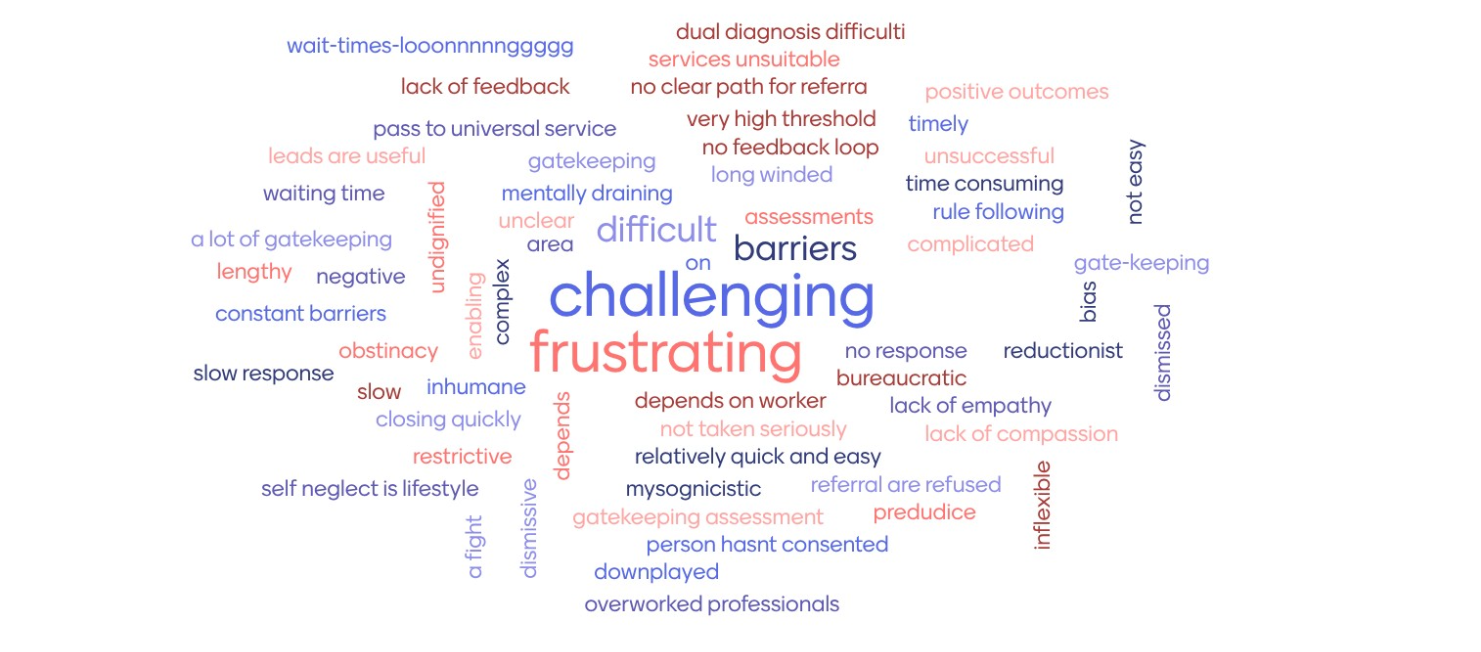
A recent session by our National Practice Development team showed just how frustrating this can be (some of the responses are in the image above). Attendees spoke of just how frequently they were forced to challenge decisions made around safeguarding and the Care Act, which can lead to an adversarial relationship between homelessness and social care teams. This can be very time consuming with no assurances of a positive outcome all while the person at the centre is stuck in crisis. Clearly, current systems are falling short.
Care and support first: the opportunities of a social care lens
Despite these challenges, the values of social work are obvious in the everyday practice of the homelessness sector. So much of what we do – relationship-focused services, unconditional positive regard, long-term support through Housing First – are firmly aligned with good social work practice.
And we don’t need to look far to see proper social care integration. Some local authorities have moved their rough sleeping teams into Adult Social Care already. A number of homelessness services have shifted to long-term models of care delivered in partnership with social care teams. Our member St Mungo’s has evidenced both the gap in care for people they support, and the difference that the right care can make.
Why do we need change? Homelessness as public health
The sheer scale of health inequalities associated with homelessness is hard to grasp. Outcomes are worse across all conditions for people experiencing homelessness, and activities that promote good health – exercise, a nutritious diet, good sleep and space to relax – are almost impossible. Data from our recent Unhealthy State of Homelessness report shows rates of disability are twice that of the general population, including overrepresentation of learning disabilities, autism and brain injury.
This is particularly stark when considered alongside data linking homelessness to thousands of premature, avoidable deaths each year. The Dying Homeless Project highlight shortfalls in ‘security, care and dignity’ as key contributors to early death among people experiencing homelessness.
What is wrong with business as usual?
Unlike social care, homelessness services are by and large funded on a temporary model. Funding is usually associated with the bricks and mortar of a service, rather than support for people who access it. Most accommodation services have a two-year limit, by which time a person is expected to have moved towards independent living. For many, this is successful, but some with enduring unmet needs may find this comes at the expense of their wellbeing.
Where these needs are identified by homelessness services, referrals may be made to adult social care. Sometimes this leads to a care package, and these can be transformative. But more often than not, our members tell us that the front door into care remains firmly closed. Inappropriate gatekeeping frequently leads to people being excluded because they are homeless. When this happens, homelessness providers are left with impossible choices: to deliver support beyond what they are designed and resourced to do, or leave the person without essential care.
Inappropriate gatekeeping means people are left in a limbo of insufficient support and worsening need. Homelessness services frequently go above and beyond to offer the best support they can, but the scale and severity of need often outstrips what they can deliver.
A double-edged sword
In the absence of appropriate social care, homelessness services are often the last line of support available for people who are acutely unwell and at high risk of negative outcomes. Stepping in to fill that gap is a double-edged sword: it may solve the immediate crisis, but it allows other services to continue avoiding their responsibility to provide care for people who need it. This has resulted in homelessness services coming to act as a shadow social care sector, without the resource, governance, or political will to deliver support that works.
The good news is that the infrastructure for better social care integration is already there. Homelessness support is about so much more than a roof – it is about connection, wellbeing, and the recognition of each person’s individual needs. With this in mind, it makes sense for us to push for a seat at the table in adult social care.
What next?
The Casey Commission offers us a rare opportunity to think about why we do what we do, and about what is missing from the system as it is. The Commission runs until 2028, and we are hopeful that our submission is a first step in positive engagement throughout this process. We will keep you updated as our work progresses.